

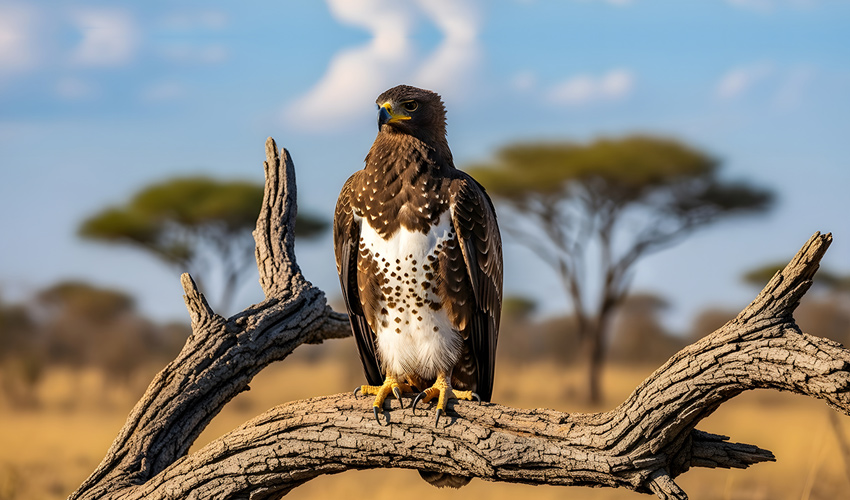
The Martial Eagle is one of Africa’s most powerful birds of prey, admired for its huge size, fearless hunting style, and powerful presence in open savannas. It’s one of the few eagles capable of taking prey that many other raptors wouldn’t even attempt, making it an important predator that helps keep wildlife populations in balance.
Quick Identification
The Martial Eagle size is extremely large, even among eagles. A quick way to recognize it is by its wide wings, strong build, and boldly patterned underparts.
- Length: 78-96 cm (30-38 inches)
- Weight: 3-6.5 kg (6.5-14 lbs.)
- Wingspan: 188-260 cm (6.2-8.5 feet)
Scientific Classification
- Kingdom: Animalia
- Class: Aves
- Order: Accipitriformes
- Family: Accipitridae
- Genus: Polemaetus
- Species: Polemaetus bellicosus
Physical Appearance
A Martial Eagle typically shows a dark brown upper body with a lighter belly that features dark spotting. Adults have a pale head and a strong, hooked beak, while juveniles often appear lighter overall with less defined spotting.
Key features include:
- strong yellow legs
- massive talons
- sharp, intense eyes
- heavy chest and broad wings
Male vs Female
Males and females look very similar in color and markings, so they’re hard to tell apart by appearance alone. The main difference is size; females are usually noticeably larger and heavier than males, which is common in many Birds of Prey.
This bird’s build is designed for grabbing prey with impact, making it one of the most effective hunters in its range.
Habitat and Range
The Martial Eagle is found throughout sub-Saharan Africa in the right habitats, usually where prey is abundant, and nesting sites exist.
It prefers:
- open savannas
- semi-desert regions
- woodland edges
- grasslands
- lightly wooded hills
Its habitat preference reflects its hunting style; open spaces allow it to detect prey from high above.
Geographic Range
The species can be found in many African countries, including:
- South Africa
- Namibia
- Botswana
- Kenya
- Tanzania
- Ethiopia
- parts of West Africa
Migration
This eagle is mostly non-migratory. Adults tend to stay within stable territories year-round. However, juveniles may roam widely before settling into their own territory, which can sometimes make them appear “wandering” or nomadic.
Diet and Feeding Habits
The Martial Eagle is an apex predator, meaning it sits near the top of the food chain and hunts a wide range of prey.
It commonly hunts:
- hares and small antelope young
- hyraxes
- monitor lizards
- snakes
- guinea fowl and other birds
The Martial eagle’s diet is broad. Unlike many raptors that specialize in smaller prey, the Martial Eagle can tackle larger animals due to its strength and speed.
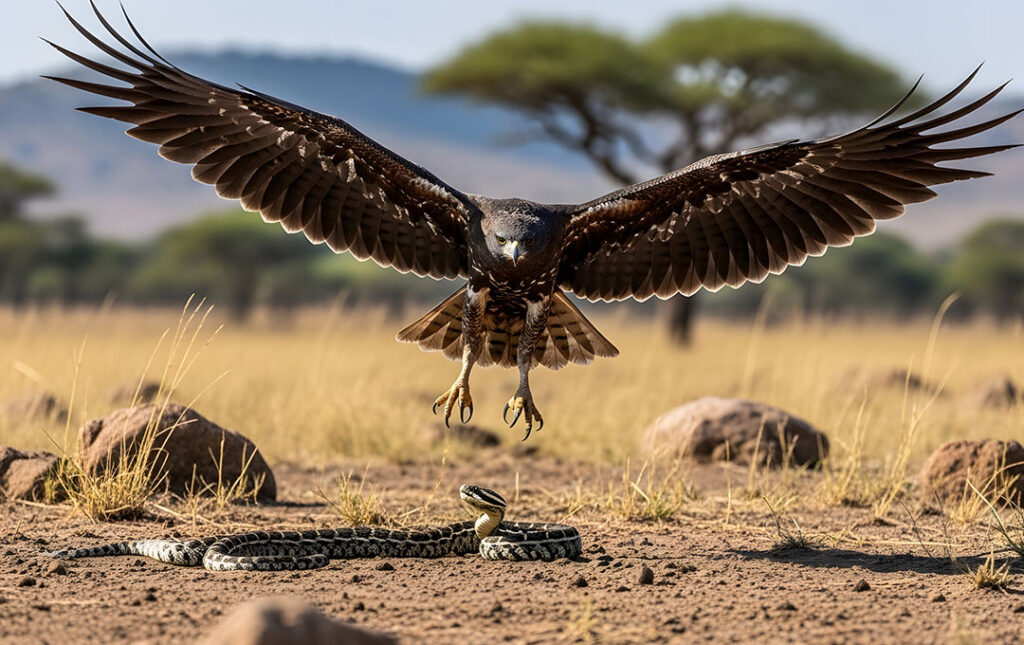
Hunting Technique
Martial Eagle hunting technique is impressive:
- It often soars extremely high and scans the ground.
- Once prey is located, it performs a rapid dive.
- The strike is powerful enough to knock prey down instantly.
This hunting style depends on open habitat, sharp vision, and perfect timing.
Behavior and Sounds
These eagles are generally solitary and territorial, especially as adults. They do not live in flocks and usually only pair up during breeding season.
Typical behaviors include:
- soaring for long distances
- guarding nesting territory
- aggressive defense against intruders
- patience while hunting
Vocalizations
Martial Eagle calls include whistles and sharp cries around nesting areas. Most of the time, they are silent hunters, relying on stealth and height rather than constant vocal activity.
Nesting and Breeding
Martial Eagles take breeding slowly compared to many birds, investing heavily in one chick at a time.
Nesting
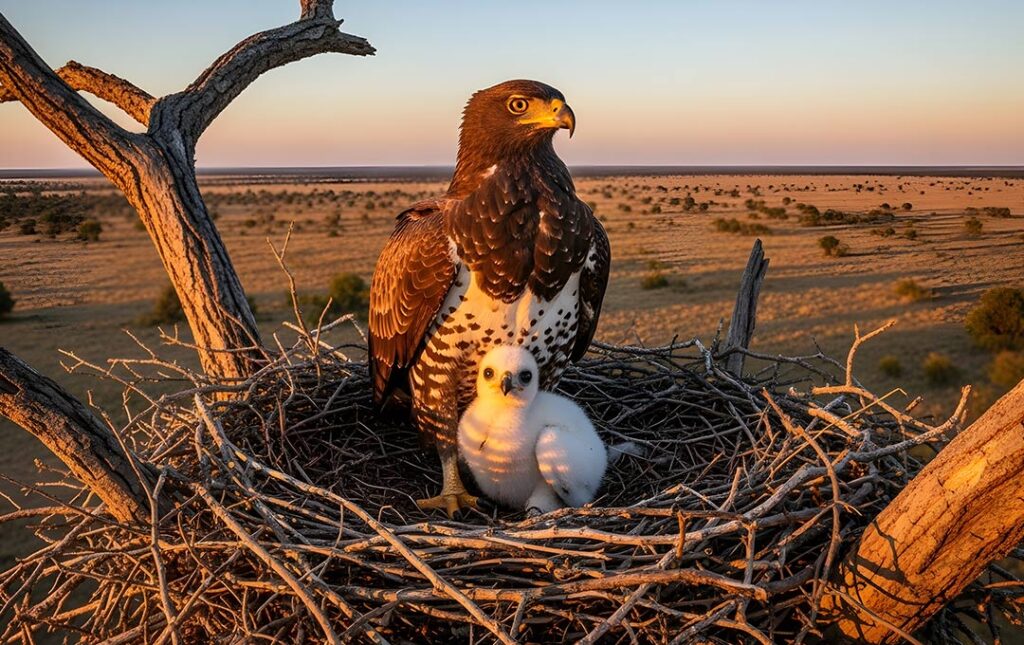
The species builds massive stick nests high in tall trees or occasionally on cliff edges. These nests can be reused and expanded over many seasons.
Eggs & Incubation
The female usually lays one egg, sometimes two, but typically only one chick is successfully raised. Incubation lasts around 45 days.
Martial Eagle breeding cycle is slower and more demanding than that of smaller birds.
Chick Development
Chicks stay in the nest for a long time, often 90-100 days before fledging. Even after leaving the nest, young eagles may remain dependent on their parents for months while learning to hunt.
Lifespan, Predators, and Survival
In the wild, the Martial Eagle lifespan is 12-14 years, and in protected environments, it may live even longer.
Threats and Survival Challenges
Adult Eagles have few natural predators due to their size. The biggest survival threats are caused by human activity, such as:
- habitat loss
- reduced prey availability
- persecution by farmers
- collisions with power lines
- accidental poisoning
Juveniles face higher risks because they are less experienced hunters and more likely to roam into dangerous zones.
Conservation Status
They are considered Vulnerable in many conservation assessments due to population declines in several regions.
A Martial Eagle’s conservation status is serious; large raptors reproduce slowly and need wide territories, so population drops can take a long time to recover from.
Why Numbers Are Dropping?
Key pressures include:
- clearing wild land for farming and development
- fewer prey animals available
- hunting or poisoning
- disturbance near nesting sites
Conservation solutions include protecting large wild areas, monitoring nests, educating communities, and improving raptor-safe infrastructure.
Importance in the Ecosystem
The Martial Eagle is essential in keeping ecosystems balanced. As a top predator, it helps control populations of certain animals and keeps prey species healthier by targeting weaker individuals.
Interesting Facts
Here are a few remarkable things about this eagle:
- Martial Eagles often hunt from extremely high up.
- They sometimes steal prey from other raptors, including hawks and smaller eagles.
- Their nest become massive over the years because the same pair keeps adding sticks.
- They can go long stretches without flapping, just gliding smoothly on warm air currents.
- Young Martial Eagles may wander far from home before claiming their own territory.
- Their feet are so powerful that one strike can instantly stun prey.
- They’re known to take birds in mid-flight when the chance is perfect.
For more bird guides like this, explore Birdsglobe.
FAQ’s
Is the Martial Eagle dangerous to humans?
No, however, it can be dangerous if approached near a nest.
How fast can a martial eagle fly?
Up to about 230 km/h (143 mph) in a dive.
Where is the best place to see a Martial Eagle?
It is often spotted in large protected savanna parks in Africa.
How high can a martial eagle fly?
It can soar very high on thermals, often around 1-2 km (3,300-6,600 ft.) above the ground.
Is a bald eagle bigger than a martial eagle?
No, the Martial Eagle is generally larger & heavier overall.